Detect tonal noise. Design stable filters. Generate firmware-ready coefficients.
SignalForge is a deterministic DSP pipeline for engineering teams.
It transforms raw time-domain samples into auditable evidence and constraint-compliant IIR/FIR coefficients
to accelerate real-world engineering decisions — without black-box optimization.
Pipeline: Analysis → Design → Verify → Report
Input: raw time-domain samples → Output: PSD/STFT evidence, filter coefficients, and audit-ready engineering reports
License: Perpetual per major version. Includes 1-year maintenance.
Example Cases (Real Outputs): A / B / C
Light evidence only: artifacts (PNG/PDF/H). No narrative.
Case A — Main Tone Protected (1000 ± 5 Hz)
Case B — Spur Removed (Auto Notch)
Case C — Low-Frequency Preserve (e.g., 50 Hz)
Hard Evidence: IIR Stability (Pole Radius < 1.0)
Optional fast audit (heuristic, not a proof): for ideal SOS pole pairs, a2 ≈ r² (used here as a quick stability sanity indicator).
(Case-matched coefficients are in each filter_coeffs.h.)
| Case | Notch Center (Hz) | Q | a2 | r ≈ (heuristic) |
|---|---|---|---|---|
| B | 597.65625 | 30.0 | 0.99739563 | 0.9987 |
Full response plots and design details are in each case PDF.
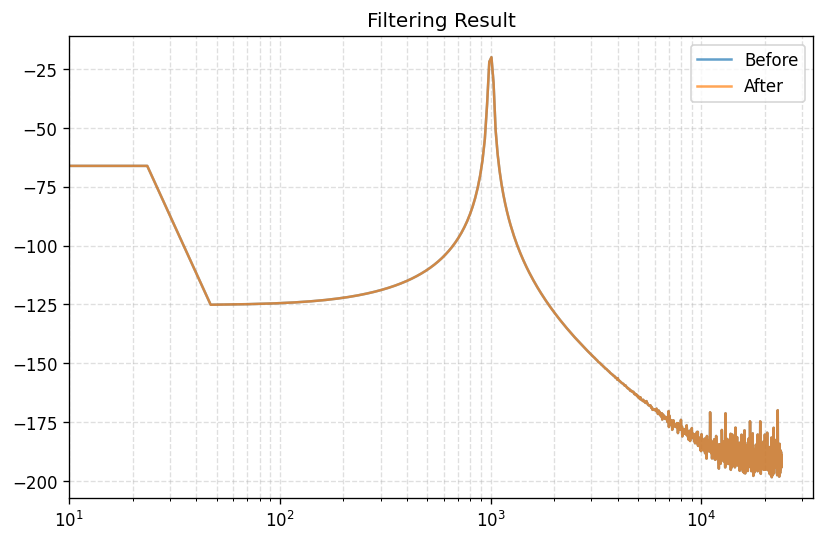
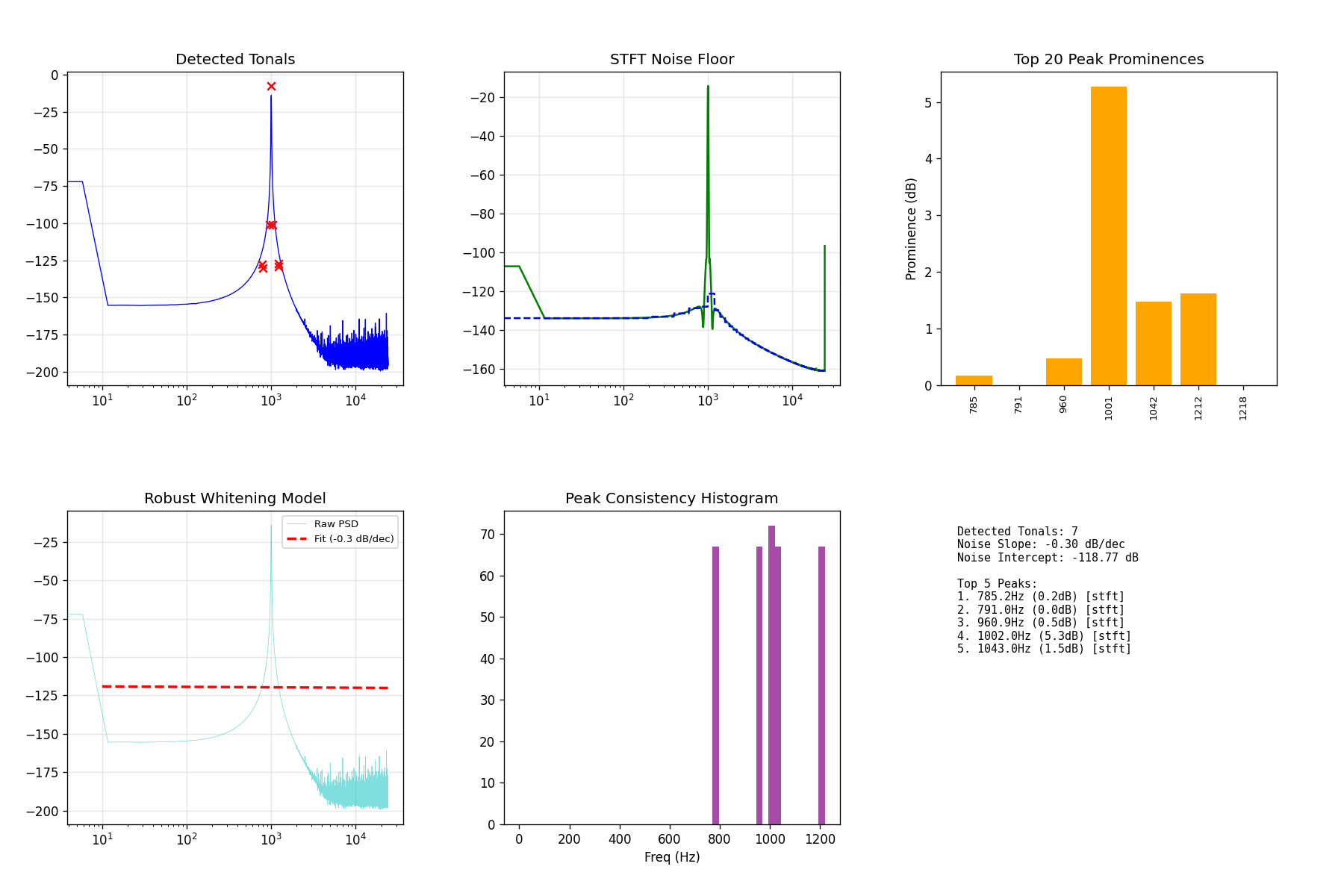
filter_coeffs.h) — SOS + FIR taps.Open: filter_coeffs.h · report.pdf
Technical Capabilities
Built for recurring engineering decisions: “What is truly tonal?”, “Will it drift over time?”, “Which designs remain stable?”, and “Can this result pass technical review?”
Statistical Characterization
Cross-check PSD with STFT to separate stationary tones, drifting tones, and transient events. Designed to reduce false positives and false notch insertion caused by spectral leakage or transient artifacts.
Drift Tracking
Uses time-frequency evidence to estimate drift bandwidth and choose practical Q-factors—so the notch keeps working after temperature/time variation.
Direct Code Gen
Exports normalized SOS and FIR taps into a C header. Avoids manual transcription and coefficient normalization mistakes.
Engineering Evidence (Auditable, Not Marketing Claims)
All figures on this page are real artifacts generated by SignalForge — not illustrative mockups.
Real artifacts you can audit (PNG/PDF/H). No narrative.
Note: artifacts shown are generated outputs (not mockups).
- Put each case under
assets/as a folder:example_case_a,example_case_b,example_case_c. - Each folder contains:
report.pdf,filter_coeffs.h,before_after_psd.png,tonal_debug.png.
Inside the Engine: Math & Verification Curious about the math? Click to audit the signal path.
1. The Diagnostic Engine (Analysis Layer)
We reject simple time-domain energy detection in favor of statistical frequency-domain characterization.
- Spectral Estimation: Welch's Method (Average Periodogram).
- Windowing: Hann Window. Chosen to minimize spectral leakage and separate weak tonal components.
- Resolution: 4096-point segments with 50% overlap. (~11.7 Hz resolution @ 48kHz).
- Robust SNR Estimation: Uses Median (50th percentile) for noise floor and 90th percentile for signal level to ignore transient spikes.
2. Filter Synthesis Architecture
Filters are synthesized specifically for 32-bit floating-point MCUs, prioritizing numerical stability.
- IIR Notch (Tonal): Uses Second-Order Sections (SOS) topology derived via Bilinear Transform. This significantly reduces coefficient sensitivity and numerical risk common in high-order Direct Form I/II implementations. Examples on this page use Q ≈ 30 as a stability–drift robustness tradeoff (user-adjustable).
- FIR Low-Pass (Broadband): Window Design Method (Hann) with Linear Phase to ensure constant group delay (linear phase response).
- Despike (Pre-Process): Kernel=3 Median Filter to remove impulsive clicks before linear filtering.
3. Verification & QA Loop
SignalForge includes an automated in-memory simulation before results are presented.
- Causal Simulation: Uses
scipy.signal.lfilterinstead offiltfiltto introduce real-world phase delay, ensuring phase and transient behavior match real-time deployment conditions. - Automated Metrics: Passband ripple is checked via Sliding-Window Peak-to-Peak; Stopband attenuation verified via 95th Percentile statistics.
4. Code Generation Standards
- Format: C99 Header (
.h). Pure C arrays/structs. No dependencies. - Normalization: IIR Coefficients are normalized such that
a0 = 1.0, compliant with standard CMSIS-DSP layouts.
Engineering Limitations
SignalForge is designed as an engineering assistant — accelerating decisions without replacing engineering judgment. The following boundaries are explicit by design.
SignalForge does not infer or optimize for system-specific constraints such as fixed-point word length, saturation strategy, CPU budget, real-time scheduling, or memory layout.
These remain explicit engineering decisions and are intentionally left under user control.
All detected tones, filter parameters, and coefficients are fully exposed in JSON and C header outputs.
Engineers are free to review, modify, or reject any design decision. SignalForge does not enforce acceptance of generated results.
User-Governed Design Parameters
SignalForge operates under explicit, user-governed engineering constraints rather than hidden optimization assumptions.
- Design scope: allowed filter types, notch count limits.
- Detection thresholds: prominence and time-coverage criteria.
- Design preferences: conservative vs. sensitive analysis modes.
- Override policy: engineers may accept, modify, or discard results.
All specifications and outputs are fully auditable via exported JSON artifacts and the C header.
Core Specifications
A rigorous pipeline designed for verification-first workflows.
- Data Import: WAV, CSV (time-series).
- Detection Logic: prominence + presence ratio (time coverage), cross-validated by STFT.
- Leakage Handling: window-aware analysis to reduce spectral artifacts.
- Health Checks: clipping, DC offset, sanity checks for signal quality.
- Filter Types: IIR Notch (SOS), FIR Low-pass.
- Deliverables:
design_result.json,noise_analysis.json,filter_coeffs.h,report.pdf. - Normalization: exported SOS uses
a0=1layout for embedded DSP loops. - Designed for: firmware handoff, reviews, QA audits, regression baselines.
The "Audit-Ready" PDF Report
The report is meant to answer “why this notch?”, “what evidence?”, “what parameters?”, and “what exactly do we ship?”—in one artifact.
Evidence Chain
Plots and tracking evidence that justify detection decisions (not just a filter response screenshot).
Parameter Traceability
Shows concrete parameters and the case context so results can be reproduced and reviewed.
Download Sample
Use it directly in technical reviews. It is a real report generated from a real input case.
Production Outputs
Zero-friction handoff to firmware engineering: no re-typing, no hidden normalization steps.
C Header Export
SOS layout: [b0, b1, b2, a0, a1, a2], with a0 = 1. FIR taps included.
JSON Artifacts
Design and analysis JSON can be version-controlled for regression testing and review traceability.
Report Artifact
One PDF you can archive, email, and attach to issue trackers or compliance reviews.
Licensing
Simple, engineer-friendly terms. No hidden subscriptions.
Price will increase after the first 50 licenses.
- 14-Day Full Feature Trial
- Offline Execution (Air-gap friendly)
- Node-locked Activation
- 1st Year Maintenance Included
- Optional Maintenance (Year 2+): $45/year
Real engineering artifacts: PSD plots · STFT evidence · C headers · audit-ready reports
The trial is fully functional for 14 days so you can validate on a real project end-to-end.
Post-Trial State: Analysis remains viewable. Code export and PDF generation require activation.
- Windows 10/11 (x64)
- Import: WAV (PCM), CSV
Quick Start Guide
SignalForge installs via a standard Windows setup wizard.
- Click any Download Trial button above.
- Run the installer (SignalForge_v1.0_Setup.exe).
- Follow the on-screen instructions to complete installation.
- Launch SignalForge from your Desktop shortcut or Start Menu.
SmartScreen Protection: Since this is a specialized engineering tool, Windows SmartScreen may appear on the first run. Click "More info" and then "Run anyway" to proceed.
Trial Mode: The application starts in a fully functional 14-day trial mode automatically. No license key is needed until you purchase.
Activation & Delivery
After purchase, you’ll receive a txn_... activation key by email. Activation is required once per machine.
- Buy on this page (Paddle checkout).
- Check your email for the Activation Key (format:
txn_...). - Open SignalForge → sidebar → Enter License Key.
- Paste
txn_...+ enter your purchase email → Activate. - Success creates
license.keylocally. After that, SignalForge runs offline.
I received the invoice, but no Activation Key email
Check spam / promotions folders first. Delivery is usually within a few minutes. If you still can’t find it, email [email protected] and include your purchase email + approximate purchase time.
Activation returns 403 / invalid_license_key
Make sure you pasted the txn_... key exactly as delivered, and that the email you entered matches the purchase email. The activation key is validated server-side and cannot be guessed.
I reinstalled Windows / deleted license.key — do I need to buy again?
No. If you are on the same machine, you can activate again using the same txn_... key.
(If you are moving to a different machine, see the next item.)
Can I activate on another machine?
The license is node-locked (one machine per key). If you need a migration due to hardware replacement, contact [email protected].
Tip: keep a backup copy of license.key if you frequently reimage machines.
Technical FAQ
Clarifications for engineering teams.
Is internet access required?
Only for initial license activation. SignalForge runs offline (air-gap friendly) for secure lab environments.
Is there any data telemetry?
No. SignalForge analyzes local files only. No signal data is uploaded.
How does SignalForge avoid “phantom notches”?
Notch candidates are evaluated using both PSD and STFT evidence (time-coverage / presence behavior). This helps distinguish a true stationary/drifting tone from short transients or leakage artifacts.
Can I import the coefficients into ARM CMSIS-DSP?
Yes. The export includes SOS layout compatible with common biquad cascade implementations (including CMSIS-style layouts).
What are the analysis modes (Standard / High Precision / High Sensitivity)?
Standard: balanced default for most signals.
High Precision: tighter analysis settings to reduce false positives (recommended for conservative analysis).
High Sensitivity: detects weaker tones but may require stricter prominence/presence thresholds to avoid over-notching.
What is the maintenance policy?
The license is perpetual for the major version purchased. You get critical fixes and minor updates for 1 year. Extended maintenance is optional at $45/year.
Policies & Legal
Support
Technical inquiries: [email protected]
Copy: [email protected]
If nothing happens when clicking “Email”, your system may not have a default mail app configured. Use “Gmail Web” or copy the address above.